
Quality Control Checkpoints Between Your Sample and Your Bulk Order
The distance between an approved sample and a delivered bulk order is where fragrance quality quietly changes, and it is covered by checkpoints, not by trust. Six gates - raw materials, compounding, filling, decoration, testing and release - decide whether the bulk run matches the sample the buyer approved. A small brand that names these gates, asks who owns each one and inspects the evidence has done more for its product than any amount of supplier confidence.
Key takeaways
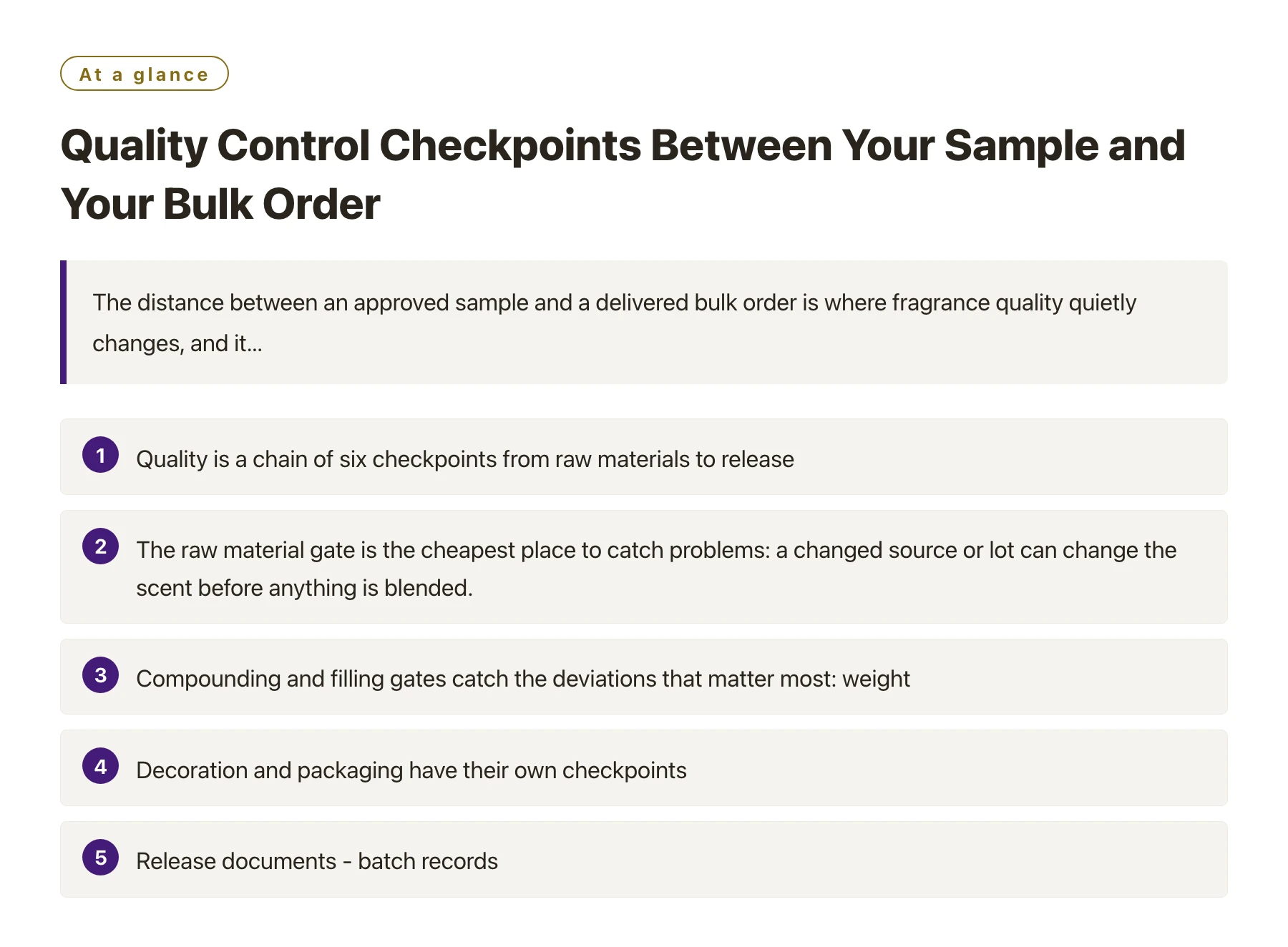
- Quality is a chain of six checkpoints from raw materials to release, and a small order should cross all of them with evidence, not assurances.
- The raw material gate is the cheapest place to catch problems: a changed source or lot can change the scent before anything is blended.
- Compounding and filling gates catch the deviations that matter most: weight, batch consistency, and the difference between the approved formula and the actual run.
- Decoration and packaging have their own checkpoints, because artwork drift and tooling variation are common small-order defects.
- Release documents - batch records, certificates of analysis, stability evidence - are the checkpoint evidence the buyer keeps and audits against on the next order.
This article is written for a buyer who has survived the sample stage and is about to place the first bulk production order. The danger zone starts exactly there: the approved sample is a small, hand-made thing, and the bulk order is a machine-made thing, and the gap between them is filled by process control or by luck.
The six checkpoints below are the standard anatomy of fragrance production quality control. The buyer's job is not to run them; it is to name them, ask who owns each one, and require evidence at the gates that matter for the product's fate in the market.
The six gates, and who owns them
Quality control in cosmetics production is anchored by a documented system, the kind of GMP framework that turns hygiene, traceability and inspection into routine rather than improvisation; testing providers describe how those frameworks translate into actual checks across the production chain [1]. Within that system, the fragrance-specific gates below are where the buyer's attention pays off.
For each gate the plan should record who inspects, what is measured, and what evidence is produced. On a small first order the evidence is cheap to collect and priceless to keep, because it becomes the baseline for every later order.
Gate one: raw materials
Before compounding starts, the materials for the run should be checked against the approved list: same sources, same lots recorded, no substitutions. Perfume is sensitive to lot variation, so the question is not whether the materials are good in theory, but whether they are the materials the approved formula specifies. Substitutions requested without approval are the classic red flag at this gate.
Gate two: compounding
The compounding gate verifies that the bulk concentrate matches the approved formula: weights per ingredient, batch number, operator and time recorded. The discipline here is the same one that makes the whole system trustworthy, which is why buyers should request a walk-through of one compounding record when they evaluate a factory.
A concentrate that is not verified against the formula at compounding cannot be fixed at filling, so this gate is the last moment where the scent itself can be protected cheaply.
The checkpoint map
| Checkpoint | What is checked | Evidence produced |
|---|---|---|
| Raw materials | Sources, lots, substitutions | Material intake records and certificates |
| Compounding | Weights, formula match, operator | Compounding record with batch number |
| Filling | Fill weight, sealing, integrity | Fill inspection sheets per batch |
| Decoration | Artwork match, alignment, finish | Decoration samples and inspection notes |
| Testing | Stability, microbiological, safety | Test reports and certificates of analysis |
| Release | Full batch review against specs | Release sign-off and document pack |
The right question at each row is 'who signs this, and where is the record?'. A checkpoint with no named owner and no record does not exist, however well the factory describes its process.
Filling and decoration: where small orders actually break
The two gates that generate most small-order defects are filling and decoration. Fill weight tolerances, sealing consistency and batch-to-batch variation are measurable and should be checked on the first bulk run against the numbers the buyer already accepted at sampling. Decoration adds its own failure modes: artwork drift between the approved proof and the printed run, alignment issues, and finish differences across lots. Because these checks span both the scent and its presentation, manufacturers that keep fragrance manufacturing under one roof have a practical advantage in controlling them, with fewer hand-offs between separate decoration shops and filling lines.
The fragrance industry's safety expectations, including how materials and their allergens are handled and labelled, sit alongside these mechanical checks and belong in the same inspection conversation [2]. A complete QC review on a first order therefore covers both the physical batch and the regulatory evidence the label depends on.
Testing and release: the gates that decide the market
The testing gate produces the evidence the market will ask for: stability data, microbiological results and the safety documentation that supports the product's claims. The release gate then reviews the whole batch - records, tests, any deviations and their dispositions - and signs it off. A batch that reaches release with every record in place is a batch the buyer can defend to an importer, a retailer or an auditor [3].
The buyer's own role at these gates is to ask for the release evidence before payment, and to keep it. On a first order, that means receiving the batch record, the certificate of analysis and the document pack in the form the destination market expects, and filing them as the baseline for the second order. Buyers who prefer supporting both booking styles at different stages of growth will find that the same checkpoint discipline applies to an a manufacturer that supports OEM and ODM relationship: the gates do not change because the model changes.
The buyer-side inspection option
Small brands rarely have their own inspectors, but a first order can still include a buyer-side check: reviewing the release documents, checking the samples drawn from the batch, and, if the volume justifies it, commissioning an independent inspection at the factory. Even the document review alone changes behaviour, because the factory knows the buyer will ask for evidence at the gates.
Linking QC to the supplier relationship
Quality control is a conversation with the counterpart, not a form. A manufacturer that documents its own quality system openly makes the checkpoint conversation concrete from the start, which is why a brand choosing a partner for its first run benefits from one whose published scope and certification claims are checkable - the kind of transparency that lets the six gates above be run against a written baseline. A company like Xuelei fragrance brand publishes exactly that kind of baseline on its site, which turns the QC plan from an abstract request into a comparison the buyer can make before the first call.
Write the six gates into the agreement as named checkpoints with evidence requirements, even on a small order. If the factory pushes back on recording evidence, note it: the pushback is the finding. If it welcomes the plan, the first order will teach you everything the second order will need.
Sources
- SGS: Cosmetics, Personal Care & Household Testing —— Testing, inspection and certification services for cosmetics and personal care, including microbiological, stability and safety testing aligned with cosmetics GMP.
- EU Scientific Committee on Consumer Safety (SCCS) —— The EU scientific committee that issues opinions on the safety of cosmetic ingredients, including fragrance allergens and their labelling thresholds.
- IFRA: Safe Use and Fragrance Science —— IFRA's explanation of how fragrance materials are scientifically assessed for safe use and how those conclusions are applied by the industry.
Frequently asked questions
Which quality control checkpoint matters most on a small first order?
The compounding gate, because it is the last point where the scent itself can be protected cheaply. After compounding, deviations become harder and more expensive to fix, so the formula-match check and its record carry the most value.
Do I need my own inspector for a small order?
For the volume of a first order, a document review plus batch samples usually suffices. Independent inspection becomes worthwhile when the order size justifies the fee; the habit of asking for evidence matters more than who reads it.
What evidence should I keep from the first bulk run?
The batch record, the certificate of analysis, the release sign-off, the testing reports and the sample drawn from the batch. These are the baseline your second order is compared against, and the file your market compliance answers from.
Can decoration quality be checked before the full batch runs?
Yes: require a pre-production decoration sample from the actual tools and materials, approved before the batch is decorated. This single gate eliminates most artwork-drift and alignment defects at near-zero cost.
What should I do if a batch fails a checkpoint?
Ask for the deviation record and the disposition decision: rework, reject or accept with conditions. A factory with a documented system will have a defined path for each; the absence of a defined path is itself the answer.