
Scaling a Small Farm: Reading a Mining Guide at Three Sizes
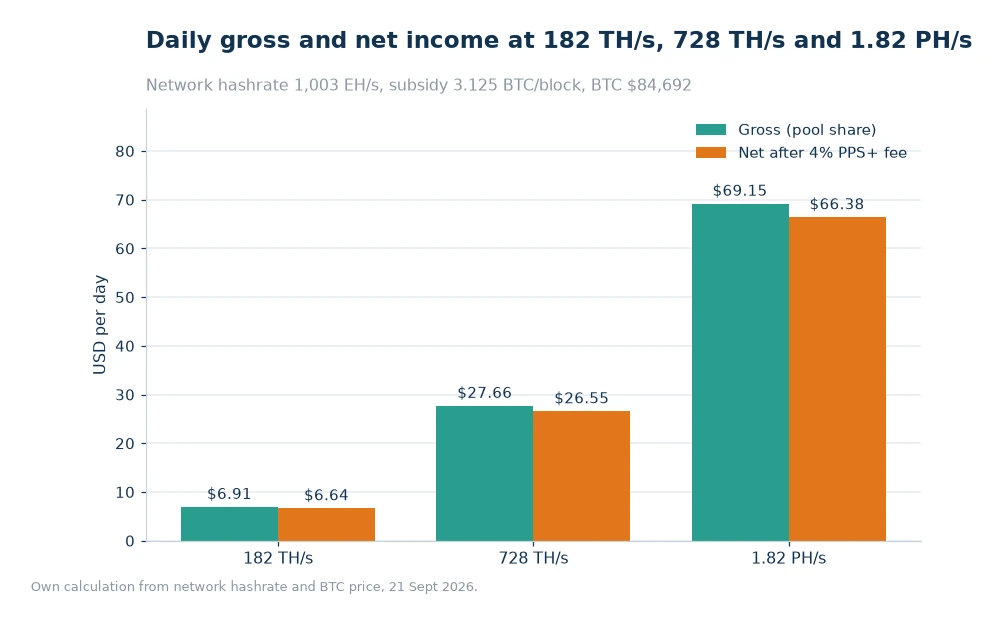
Four small machines and one large one can produce the same coins and behave nothing alike. At 182 TH/s a unit credits about 0.00008165 BTC a day, $6.91 gross and $6.64 net; at 728 TH/s the same arithmetic gives $27.66 and $26.55. The gap between those two sentences is where a second hardware order is won or lost.
Key takeaways
- Doubling from 182 TH/s to 364 TH/s doubles gross income to $13.82 but leaves rent, monitoring and network gear unchanged.
- At four units, 728 TH/s credits $26.55 a day after the listed 4%, before power and site costs.
- PPS+ pays the reward side hourly, so a four-unit farm can compare its account line with the formula every morning.
- A guide is due diligence on process, not a substitute for a supplier's written terms.
One unit or four: the question a guide cannot dodge
The first machine is a hobby with a spreadsheet attached. The second order is a business decision, even if the business is a shed. You are no longer asking whether mining works; you are asking whether four identical boxes in the same room beat one bigger box, and the answer depends on costs that have nothing to do with hashing.
A guide helps by describing the parts that stay constant as you scale, and the ViaBTC Mining Guide covers them in the order you will meet them. Account structure, worker naming, payout address, settlement timing and the fee split behave the same at 182 TH/s and at 728 TH/s. What changes is the physical plant: circuits, cooling, floor space, spare parts and the number of things that can fail on a Sunday.
The fourfold ladder in coin terms
Start with the clean part. One 182 TH/s unit produces 0.00008165 BTC a day at 1,003 EH/s, which is $6.91 at $84,692. Four units produce 0.00032662 BTC, or $27.66 gross. The listed 4% on the block-reward side turns those into $6.64 and $26.55, and the ratio stays exactly four because the fee is proportional.
So far the ladder is friendly. Every additional unit adds the same coin output, and there is no penalty for operating several workers under one account. The pool sees shares, not rooms. If the story ended here, everyone would keep buying units until the shed ran out of wall.
Where fixed costs bend the ladder
The story does not end there. The table adds two cost lines that a coin-only view hides, using 20 J/TH as a planning assumption and $0.06 per kWh. These are scenario inputs, not a specification for any particular model.
| Line | One unit (182 TH/s) | Four units (728 TH/s) |
|---|---|---|
| Daily BTC | 0.00008165 | 0.00032662 |
| Net after the listed 4% | $6.64 | $26.55 |
| Power, 20 J/TH at $0.06/kWh | $5.24 | $20.97 |
| Left before rent and repairs | $1.40 | $5.58 |
The last row is the one a guide should prepare you to calculate. Power scales almost linearly with hashrate, so it does not rescue a thin margin; it multiplies the exposure. Rent, a network link and a monitoring subscription, by contrast, are flat. Four units spread those flat costs over four times the output, which is the real argument for a small farm.
Settlement terms before the second order
PPS+ is the default and the reason a four-unit farm is easier to run than four separate accounts. The block-reward portion is settled hourly against current difficulty, so each morning's credit reflects the previous day's shares rather than a pending block. The transaction-fee portion follows PPLNS logic at a listed 2% and arrives under its own rules.
That difference matters more at scale, because a farm watches cash flow weekly rather than annually. Hourly settlement turns the account page into an operational signal: a unit that stops submitting shares shows up as a step down within a day, not at the end of a month. Use it that way and the settlement scheme becomes a monitoring tool as well as a payment method.
What a guide can prove about a supplier
Almost nothing, and that is worth saying plainly. A guide explains how the pool works; it does not audit the company selling you hardware, the electrician wiring the room, or the landlord granting a lease. Those are separate documents with separate signatures. Reading one and assuming the others is how a farm ends up with four miners, one circuit and no written permission to run them.
What the guide can do is give you the vocabulary to ask precise questions. Ask what the all-in power cost is, not what the rent is. Ask who pays for a failed power supply, not whether the seller is reliable. Ask what notice the lease requires before you install anything that draws 15 kW. The answers are yours to file next to the order confirmation.
A due-diligence list for order number two
Before the second order, confirm five things in writing: the available circuit capacity, the cooling capacity at summer ambient, the all-in power tariff, the repair policy on the units you already own, and the date by which the new units will be hashing. Only the last one appears on a shopping page. The other four decide whether the fourth unit earns $6.64 a day or nothing at all.
Then run the arithmetic backwards from the margin. If one unit leaves $1.40 a day before rent, four leave $5.58, and the question becomes whether $5.58 covers the space and the attention. At a $200 monthly rent for the room, that is $6.67 a day, which is more than the whole surplus. The farm is not automatically better because it is bigger; it is better only when the flat costs are genuinely shared.
Worked example
Follow one unit through to the power line, then multiply by four.
- Daily BTC per TH/s: 450 ÷ 1,003,000,000 = 0.00000044865.
- One unit: 182 × 0.00000044865 = 0.00008165 BTC a day.
- Gross in dollars: 0.00008165 × 84,692 = $6.91.
- Net after the listed 4%: 6.91 × 0.96 = $6.64.
- Power at 20 J/TH: 182 × 20 = 3,640 W, or 3.64 kW; 3.64 × 24 = 87.4 kWh; 87.4 × 0.06 = $5.24.
- Four units: 4 × 6.64 = $26.55 net, 4 × 5.24 = $20.97 power, leaving $5.58 before rent.
Frequently asked questions
Does a second unit double the profit?
No. It doubles coin output, from 0.00008165 to 0.0001633 BTC a day, but power also roughly doubles while rent and monitoring do not, so the surplus grows by less than the revenue.
Is PPS+ better for a small farm than PPLNS?
PPS+ settles the block-reward part hourly at a listed 4%, which suits weekly cash-flow checks; PPLNS charges a listed 2% on both parts but pays after six confirmations and shares over the last five difficulty rounds.
What should a guide not be used for?
It should not be used to judge a supplier or a landlord. It explains pool mechanics; wiring, tariffs, leases and repair terms need their own written confirmation.
Run the four-unit case before you run the cable
Take the net figure for one unit, multiply by the number you intend to run, then subtract the power line and every flat cost you can name. If the result is still positive at a tariff higher than today's and a difficulty estimate worse than −2.12%, the plan has room. If it is positive only at the current price, the plan is a bet on the price.
The pricing page keeps the listed rates in one place, and the Miner Profitability Ranking puts current models next to current conditions. Neither will size your circuit. That number comes from an electrician, and it belongs at the top of the page.
Sources: ViaBTC pricing, miner ranking and support pages for settlement terms and setup. Chain inputs read 21 Sept 2026: network hashrate 1,003 EH/s, subsidy 3.125 BTC per block, 144 blocks a day, BTC $84,692. Power figures use a stated 20 J/TH assumption and $0.06 per kWh, not a product specification. Figures read 21 Sept 2026, published 24 Oct 2026[1].